Sunday, 6 July 2014

Lets Have a Demonstration!

driver coaching Nottingham

Demonstrations are an important part of driver training.

In unit 6.3.2. of the National standard for driver and rider training we look how to explain and demonstrate skills and techniques. This unit will seem familiar to most driving instructors who do this sort of thing every day. Like most instructors I mainly give demonstrations when it comes to manoeuvres or junctions unless I think there's a need to demonstrate on another subject. I find pupils are reluctant to request a demonstration so I always tell them I'm happy to demonstrate anything they want if they think it will help.
   \Regarding the performance standards of this unit we must be able to select suitable locations for a demonstration. Pretty easy if it's a manoeuvre. The suitability of a location would seem to be obvious. If you want to demonstrate roundabouts then it will have to be where the roundabouts are. However the difficulty level of the location must be taken into account. What may be manageable for the instructor may be too demanding for the pupil.
   We must provide timely and appropriate explanations and demonstrations of the required skills. Most of the time this is simply talking yourself through the subject while you put it into practice in front of the pupil. Sometimes it pays to perform the skill a little slower than if it was a natural drive to allow for a clearer talk through. I like to do one with just me talking and then see if the learner has any questions. I'll then do a second demonstration based on what has been asked. That way it's not just me showing off that I can do it.
   We must make sure that the learner understands any theory that links to the demonstration. I find the best time to demo something is right after a briefing with a diagram. That way the info is still fresh in the pupil's mind. After the demo we need to make sure that learners have enough opportunity to practice. No point doing a demonstration at the end of the lesson. As the learner practices we need to give feedback. This is a more straightforward unit as the vast majority of driving instructors will be putting these things into practice anyway.
   Where possible we need to be able to encourage learners to practice in a structured way outside of lessons during private practice. To facilitate this I made videos which can be watched on You Tube. Each video contains an explanation and a demonstration for that particular topic. That way learners can remind themselves in between lessons. parents and other accompanying drivers can also check that they are teaching the right stuff. Next time we will be looking at the element on coaching. Should prove interesting.


Tuesday, 24 June 2014

The Car is the Classroom

friendly Nottingham driving instructor

There are things we must know and understand.

Continuing with our look at Element 6.3.1. of the National standard for driver and rider training we must not hesitate to take a look at our knowledge and understanding of teaching driving head on. To kick off we need to make sure we are communicating properly with our pupils. With more people from overseas taking lessons it's important that we can assist in getting through the language barrier. Making eye contact is something I approach with a small amount of caution. Some people just don't like it. In a car our faces are pretty close together and it can seem a little threatening or overwhelming to some. It's good to offer eye contact and if the pupil does not reciprocate I just stop doing it and look at the diagrams instead. Worst of all are the ones who make eye contact while the car is moving at speed. I find this a bit scary and address the issue at once.
   Using consistent language is a good way to start a course of lessons. Especially when it comes to giving directions or referring to the controls. I like to keep these consistent but it's often better to talk to the pupil naturally once you have got to know them I think. Relating to people informally at times can help deepen the instructor pupil relationship. All my reviews come from the people I got chatty with rather than just using instructor language. It's all about adapting to your pupil. 
   When it comes to breaking subjects down and using diagrams I'm a big fan. I don't really consider a subject covered unless there's been some diagrammatic input but that's just me. I find that questions go hand in hand with a diagram. Inviting the pupil to draw on it to show what they think is a good technique.
   Setting out guidelines on acceptable behaviour in the car is not something I have considered doing. Most people behave themselves and I think I'd find it a bit patronising towards the client. What would be unacceptable behaviour anyway? You can't tell people how to dress or what words are unacceptable really. I suppose poor behaviour means smoking and eating. I'll allow for cigarette breaks during lessons if that's what the pupil wants but not in the car. Don't bring chips either.
   We are really entering the new age of awareness with the next item which is the effect of our own assumptions on particular groups and how they effect our ability to deliver effective learning. I am so guilty of doing this but like to think that I still do the job properly. There are certain areas of town where I pick people up who look a certain way and I'm already deciding that this is going nowhere. I'll just turn up one day and they won't be in. Not even bothering to call and cancel. Unfortunately these gut feelings often turn out to be true. As we are all people there will be these unspoken assumptions. It's part of who we are and how we view the world. I think if you are aware of your attitude towards others then it's quite easy to get round it and deliver a worthwhile lesson.
  There are a few more points which either repeat what has already been said or simply read as management gibberish before we reach the last point about exterior influences on the learner's attitude. This can be a big problem and unfortunately often comes from parents. They only had a certain number of lessons so that's all they're willing to pay for which makes me rush things. I've said something about real life driving and danger which has upset their precious offspring. it's stuff they need to know and if they can't handle a bit of reality then they shouldn't be driving at all. I have a job to do to produce safe and intelligent drivers and I aren't going to do it by avoiding the real life issues. So there. Next time we move on to the next element which is all about skills and techniques. Should be good.

driving lessons around Nottingham

Professional driving school Nottingham

Tuesday, 17 June 2014

A Change in Climate for Driver Training

deeper-learning-driving-instructor

Create a positive relationship with learner drivers.

I've got to say since I started studying the National Standard document and began putting it's ideas into practice I have really enjoyed how it's changing the way I deliver lessons. My pupils seem to respond well to the client centred approach and it's made for some very enjoyable sessions. Maybe it really does work. This week I'm into unit 6.3.1. Let's have a look at what it's all about.
   Learners who are not actually engaged in the learning process and just sit there absorbing information are not equipped to drive safely after the test it seems. I can understand that. Get people thinking for themselves and you're on to a winner. The performance standards section tells us that we must establish an efffective method of communication, verbal or otherwise that is free from discrimination. This may mean avoiding words which could be taken the wrong way or be considered offensive. This can be a bit of a minefield in these times of everyone taking offense at the least little thing. Any good instructor should be able to talk to someone and be able to avoid areas which may become tricky. If you stick to talking about driving then not much can go wrong really. I'd say the main danger is when the instructor and learner enter into general conversation.
 We must not exploit learners and collude in risky behaviour or attitudes. I've had a few young male drivers who have tended to brag about their illegal driving days and the things they got up to. I try to be diplomatic about this. Challenging attitudes about speed limits and driving under the influence of drink or drugs need to be handled with care so the atmosphere in the car does not become confrontational. If a learner decides that they don't like the way you talk to them they will just go elsewhere for their lessons. This is obviously bad for business. If you can bring them on side and make them think then they are more likely to accept good advice and refer you to other people.
   The learner must understand the requirements of the learning programme. I take it this means the DVSA learning to drive syllabus. On the odd occasion I have recommended  the Driving the Essential Skills book but the uptake on people reading this is very low indeed. Pupils tend to think that the instructor knows what to deliver and they just accept that this will happen. I like to make sure that the learner knows that we work in partnership as they learn to drive and this does help create a friendlier atmosphere. It works wonders with pupils who may have a problem with authority and generally being told what to do.
  The learner needs to understand what other opportunities and resources are available for them to include in their learning process. This I think means guidance when practising with parents or using online materials outside their formal lessons. You Tube videos are becoming increasingly popular in this regard. When it comes to practising with parents there can be a sometimes be a problem with conflicting information. On occasion I have had a chat with parents who were simply teaching out of date methods. It's a long time since they took their test and they too can benefit as they help their children to drive.
   I like to write my notes on the lesson at the end of the session in the car and include the learner in the process. This gives a level of transparency and grows trust with the pupil in my experience. This way I am explaining how I monitor and evaluate the training and gives me a chance to agree on the content of the next lesson, fulfilling item 8 in the column. All good stuff this. Next time I'll be looking at the knowledge requirements for this module.


Tuesday, 3 June 2014

The Joy Of Designing Learning Programmes

Professional Driving Instructor Nottingham

It's all about knowledge and understanding the requirements of Unit 6.2.

This has been a week of study of the National standard for driver and rider training document. Well, not every hour of every day but you know what I mean. Looking in the right hand column of unit 2 we see that item a) tells us we must know and understand the relevant National driving or riding standard. So by reading it I am fulfilling this condition at the same time. That's good to know.
   Moving along we see that we must understand the requirements of acquiring a licence for the tuition vehicle which is straight forward enough. Next item regards the requirements of any formal post test training. I would think this means either Pass Plus or an advanced driving test with one of the motoring organisations such as Diamond or RoSPA. If you are registered as a Pass Plus instructor then all the information is in the pack. I would think many driving instructors will belong to an advanced driving organisation and so should have some knowledge of post test training.
   We need to understand a range of prior-learning inputs and how to feature them in how the learner is taught. Does this mean experience of riding a bike? I suppose practise taken with parents would count as a prior-learning input, as would any study for the theory test. Anything previously experienced that has anything to do with driving could be used in some way or another. It can boost a learners confidence to think they already know something which will help them to drive. 
    Cultural and religious factors must be taken into consideration when arranging driving lessons. Some people may not be able to attend on certain days. I had a refresher lesson on a Saturday with a client who recognised the Sabbath. He could have his lesson but couldn't pay for it. I just waited a couple of days to get paid. No problem. When it comes to fasting there can be some disruption. driving performance does deteriorate when people are fasting in my experience. People get up early to eat before sunrise so lack of sleep can factor into the equation.
  If people don't want to make eye contact then that's fine by me. Sometimes it's a cultural issue. It's not something I insist on and I never find it rude if people don't look at me when I'm speaking. What worries me more is people who do make eye contact when they are driving the moving car. I always advise to look at the road and speak. People from some cultural backgrounds do not like to contradict the teacher. I find questions a good way around this. Answering a question honestly is not actually contradiction even if the answer is a different view from the one expressed by the teacher.
  I don't know of anyone who uses psychometric tools. But we must understand the ethical issues it says here. Where does one go to study these issues? I'm sceptical of these things anyway. People have a certain view of themselves which is personal to them. When this view is combined with a subconscious desire to please or at least be correct the data acquired simply can't be accurate.I can't see much scope for it's use in driver training.
  Now we come to the section on learning programmes. Like many instructors I don't work from written plans or pre-prepared programmes specific to the learner. I make notes and refer to them, sure. The actual lesson content follows the learning to drive syllabus but apart from that the lessons are shaped by what occurs during the drive. Not according to a plan I wrote the night before. Plans change anyway as you respond to your learner's needs. This was an issue on the check test where the instructor would be expected to shift the focus of the lesson if that is what was needed according to the situation at the time. It's all about flexibility.
   Fostering good relationships with parents is important should the need arise. I must admit I very rarely meet or speak to parents. What I like to do though is regularly monitor and review my pupil's progress. I will shape future lessons on the result of these reviews but it's not like I rewrite a learning programme. The instructor, the pupil and the driving test syllabus is the learning programme and everything else stems from this. Have a read of the document to see what else this section says as I'll be moving on to unit 3 next time. Ciao.


Tuesday, 27 May 2014

Client Centred Learning in Driving Instruction

client centred driving lessons Nottingham

Taking a look at unit two of the National Standard for driver and rider training.

Unit two takes us into the realm of teaching with a focus on designing learning programmes. If like me, you tend to deliver a course which covers the entire syllabus for learning to drive then you've got to be able to readily adapt to the individual needs of the pupil. This can be a bit tricky at times when learners just don't seem to be getting it. Good use of question and answer technique is the best answer to this problem I find. It sometimes takes a bit of detective work to find out where the difficulties lie.
   According to the performance standards you've got to be able to confirm that the learner has a provisional licence, first thing most instructors do I'd say. Also confirm that the learner's eyesight is up to the minimum requirement. I'm guilty of leaving this until later with some pupils. If they're wearing glasses then I assume their eyesight has been tested. I really must start checking this on the first lesson.
   A few questions will enable a driving instructor to check the previous experience of the pupil. Like if they've had lessons before or they've been practicing with friends or parents. It's now a requirement that you can refer pupils with learning disabilities to someone with the appropriate knowledge needed to teach them. I know of an instructor I would send people to if I felt that I couldn't provide the learning support they need. It's probably a good thing to do a bit of internet research and make a note of instructors in your area who provide such a service.
   When it comes to an outline programme I use the approved syllabus for learning to drive broken down into the separate topics. When it comes to creating lesson plans for each session that outline objectives it's a different story. It would simply be too much work for a driving instructor to come home after a day on the road and start writing out lesson plans for the following day's pupils and I don't really see any need for this. I simply refer to the notes made after the previous lesson with the pupil sat in the driving seat and we take it from there. In a client centred approach I would say this is the way to go. The pupil is reminded of previous learning and has a hand in deciding what they want from the current lesson.
   When it comes to learning resources I usually refer people to my website which has all my videos and things on. As they match my day to day teaching style it's a good way to jog the memory and reinforce learning. Include third party resources where this will benefit the learner, it says in the document. Again it's probably worth having a look on the internet and sourcing some good materials so you can give a list of these to your pupils for homework.
   We now need to specify how parents and guardians can support learners with physical and cognitive disabilities. This would take specialist knowledge I think. It's good to include guidance for any pupil who is practicing with parents and suggest the topics that they need to work on as well as the type of roads they are competent to drive on. Don't want things getting too scary when they are out in a car without dual controls. 
   Lastly we must specify how we will review learner progress and programme effectiveness. I like to do a review by driving around a route from the beginning of the training and comparing how the standard of drive has improved from the early sessions. This can be a real boost for pupils who feel they aren't getting anywhere. At the later stages a mock test is effective as a review tool. Next time I'll look at the knowledge and understanding requirements of unit 2.


Tuesday, 20 May 2014

Driving Instructors - Meet All Legal Requirements!


top-driving-instructor-nottingham
Unit 1 of the National standard for driver and rider training.

I thought it was about time I read the National Standard document. It's important for driving instructors to keep on top of new developments, especially in light of the new ADI standards check criteria.
   I usually find official documents hard to read without my mind wandering. The bullet points and dry language used combined with the sometimes vague statements make for hard work. I read a lot of different stuff but hardly ever anything that was written in an office.
   Unit 1 is all about the legal requirements that must be met before teaching someone to drive or ride. Most items are common sense regarding the displaying of L plates, minimum test requirements for the vehicle so it's fit for purpose and making sure that it's insured for learners. I didn't know that having the vehicle serviced to the suppliers recommendations was a requirement. Sure, I get mine serviced as per the schedule and all instructors would I reckon. If a test candidate turns up in their own car can an examiner ask to see the service schedule? If so then a test could be cancelled if evidence of servicing could not be provided. If an instructor is late getting the car serviced then it would mean that the vehicle does not meet the requirements of the National standard. Interesting.
   You must be able to carry out corrective actions that are within your authority. Does this mean that you must be able to change brake light bulbs and such if they are found to be defective? I always carry a spare bulb kit in the boot and I've replaced brake light bulbs a couple of times on the spot so the test can go ahead. I didn't know it was a requirement that instructors know how to do this. I suppose there are some who don't. It annoys me that some cars have headlights that are not user serviceable. You have to take the bumper off to get to them. That wouldn't look good in the test centre car park.
The last part of this unit says you must be able to make other arrangements when a vehicle is not fit for purpose. You need to know what action to take if the documents are not in order, it's not been serviced or it fails any checks. If the matter comes to light at the beginning of a test I'd say there's precious little you can do about it anyway. Far better to make sure that your vehicle is in tip top condition and fully insured before you get there. I might keep the service schedule book I get stamped in the glove box now. Just in case anybody asks. I'll be taking a luck at unit 2 this coming week. What delights could be in store?


Wednesday, 14 May 2014

Driving Video Games Help You Pass Your Test!

But you're more likely to have an accident within the first year of driving.

Take driving lessons in Nottingham
It's official. A new survey undertaken by a leading car insurance firm reveals that gamers have a 15% better chance of passing the driving test first time. However, 77% of the gamers admitted having an accident within their first year of driving. This figure is higher than the national average.
   It seems the video racing game enthusiast enjoys an increased sense of confidence owing to their simulated experience of blasting round a race track in a high performance vehicle. This same confidence can lead to a false sense of security and an over estimation of your driving abilities after the test, leading to traffic incidents. As anyone who has taken the driving test knows, you need a good deal of confidence on the day. Afterwards you need to be careful and drive within your limits as you gain solo experience.
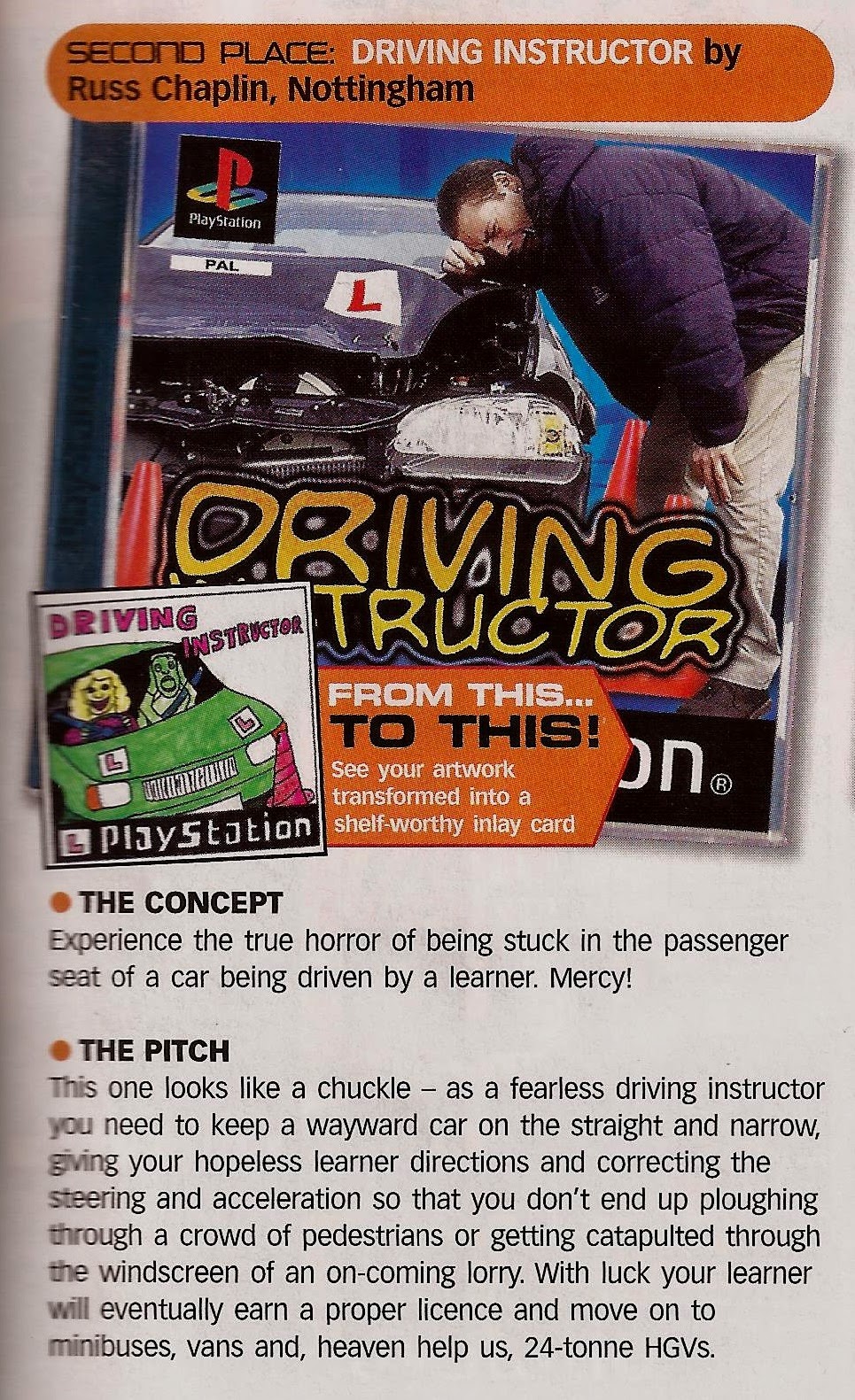
   As you can see from the photo I pitched an idea for a different kind of game way back in 2003. 2nd place in the Playstation official magazine competition. All light hearted stuff. I'm sure an entertaining game could be made that does actually test real life driving skills. The driving simulators I have seen seem to be very dull like you're driving around in an abandoned world designed by robots.
   I never excelled at driving games at first. I just couldn't get my head round the physics. When to brake and how much eluded me so I never stayed on the track. It was rally games that helped me find my feet. I seemed to be much happier when the car was sliding around. I'd often beat the game clock on the snow and mud then lose pathetically on tarmac. Perhaps I should take a skid pan training course to see if I can do it in real life.
   The chav favourite Need For Speed is one I can handle. The cars drive like the sort of car I might be able to afford one day. The city streets are well constructed as well so it pays to look well ahead and anticipate where the road is going. Essential skills for the safe driver. F1 games I cannot handle at all. I simply can't relate to the simulated high speed and the steering is twitchy. 
   If there's one game I could call myself Master on it was Wipeout3. Racing a futuristic hover ship round a purpose designed track was pure brilliance. There was a definite physics to it making it totally controllable. Nobody I knew could challenge me. I was indeed king. 
   The upshot of all this is yes, enjoy your gaming as I do. Just remember the confidence you gain can work both ways. A little confidence is a good thing in driving but over confidence brings it's own dangers.